
Sun care guide
for acne-prone skin, without the greasy finish
A breakout that leaves a mark for weeks, a T-zone that shines by noon, a sunscreen that pills over your serum: finding the right protection can quickly become discouraging. Yet this sun care guide for acne-prone skin starts from a simple idea: your skin doesn’t have to choose between high protection, comfort and a clean finish. It needs a formula suited to its balance.
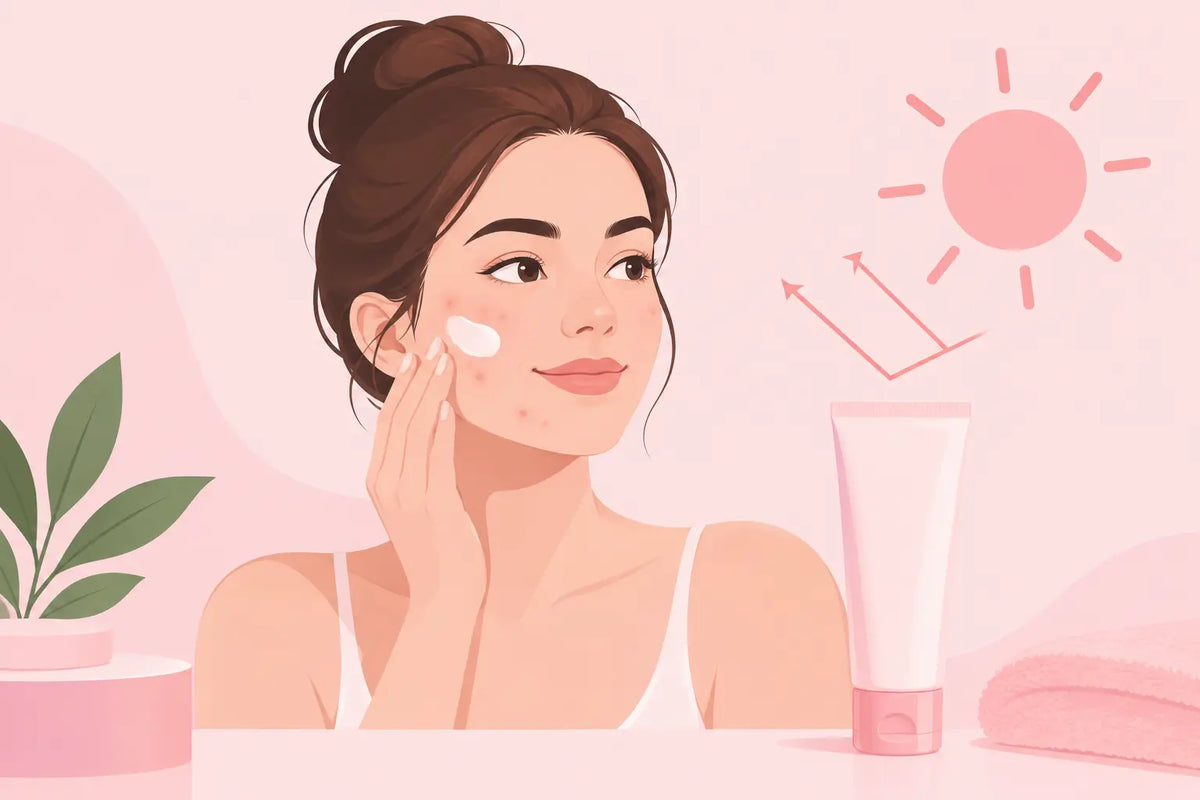
Acne is no reason to cut back on or skip sunscreen. On the contrary, UV rays can heighten inflammation and darken the marks left by breakouts. The right sunscreen protects your skin every day while respecting its pores, its sensitivity and its hydration needs.
Why the sun can worsen acne marks
After sun exposure, breakouts sometimes look less noticeable. A tan temporarily evens out the complexion and can make skin look clearer. But this effect is often short-lived. UV rays stimulate melanin production, which can make post-acne marks browner, more visible and slower to fade.
Skin can also thicken in response to the sun. In some people, this then encourages clogged pores and new flare-ups. If you use exfoliating actives such as AHAs, BHA or retinol, this vigilance becomes even more important: these routines can make skin more reactive to sunlight.
Sun protection is therefore as much a corrective step as a preventive one. It helps preserve a radiant complexion and supports the results of a well-built anti-blemish routine. It doesn’t treat acne directly, but it keeps each breakout from leaving a more stubborn mark.
Sun care guide for acne-prone skin: the key criteria
The first benchmark is the level of protection. Choose an SPF 50, ideally broad-spectrum, to cover the UVB rays responsible for sunburn and the UVA rays that contribute in particular to skin ageing and dark spots. In mainland France as in Réunion, this level of protection is especially relevant for daily exposure, commutes, terraces and bright days.
Don’t stop at the word “non-comedogenic”. This claim can be reassuring, but it doesn’t guarantee that a formula will suit every skin. Tolerance also depends on your sebum production, any treatments you’re using, the amount applied and how many layers build up in your routine. A light formula that makes you want to apply the right amount will often be more useful than a sunscreen that is perfect on paper but left aside because it is too rich or too shiny.
Texture matters enormously. Fluids, sun essences, gel-creams and watery finishes are often popular with combination to oily skin, because they spread easily without a suffocating feel. Acne-prone but dehydrated skin may, however, prefer a more cocooning cream. Producing sebum doesn’t necessarily mean being well hydrated: tightness, flaking and discomfort are signals worth listening to.

Organic or mineral filters: which to choose?
Organic filters often offer thin, transparent textures that feel very pleasant under makeup. They are an excellent option if you’re looking for an invisible finish with no white cast and easy daily application. Korean formulas are particularly known for this lightweight feel, designed to be worn every morning without compromise.

Mineral filters, based on zinc oxide and titanium dioxide, are often preferred by very sensitive skin, skin prone to redness or skin sensitised by a dermatological treatment. Their possible downside: a thicker texture or a white cast, especially on medium to deep skin tones. Tinted formulas can then be an elegant solution, provided the shade and finish truly suit you.
There is no universal winner. If your skin tolerates both, the best choice is the one you apply generously and consistently.
The ingredients that make the difference
A sunscreen for acne-prone skin doesn’t need to pile on promises. A few well-chosen ingredients can nonetheless improve comfort and support a targeted routine. Niacinamide is valued for its action on sebum balance, the look of pores and an even skin tone. Centella asiatica is particularly suited to skin that flushes easily or has been overworked by exfoliants.

Green tea, aloe vera, panthenol, ceramides or hyaluronic acid can help maintain a comfortable skin barrier. Less irritated skin is often more stable and tolerates treatment products better. If you use salicylic acid in the morning, watch your skin’s reaction closely: some routines handle this combination, others prefer to keep BHA for the evening to lighten the layers of product.
On the other hand, be careful with heavily fragranced formulas if your skin is inflamed or sensitive. Fragrance isn’t automatically a problem, but it adds nothing to sun protection and can cause discomfort for some people. The same logic applies to very rich textures: they aren’t forbidden, but they may not suit oily, congested skin or skin exposed to intense heat.
Applying the right amount without making your skin shine
An under-dosed SPF 50 doesn’t protect as intended. For the face and neck, aim for the equivalent of two finger-lengths of product. This method isn’t millimetre-perfect, but it gives a reliable benchmark to avoid applying too little.
If that amount seems hard to keep on, apply it in two thin layers. Let the first settle for a few moments, then add the second. The result is often more even, with fewer streaks and less risk of pilling.
For a smooth application, follow this logic:
- a gentle cleanser and a light serum if your skin needs it;
- a thin moisturiser, only if the sunscreen alone isn’t comfortable enough;
- SPF 50 sunscreen as the last step of your morning routine;
- reapply every two hours when exposed, after sweating or swimming.
Indoors, reapplication depends on your actual exposure. Near a very bright window, in the car, during a break outside or in an intense climate, it makes perfect sense. If you work from home away from windows, a generous application in the morning may be enough depending on your situation. The goal isn’t to follow an anxiety-inducing rule, but to protect your skin consistently.
Adapting your sunscreen to your type of acne
If your breakouts are mainly linked to excess sebum, look for a fluid with a natural or semi-matte finish. It may contain niacinamide or absorbent powders, without making your skin look dry and flat. A slightly luminous finish remains perfectly compatible with oily skin: what matters is the absence of a heavy film and how shine evolves over the day.

For inflammatory acne, with red spots and sensitive areas, go for a minimalist, soothing formula without a pile-up of powerful actives. Your priority is tolerance. Trying too hard to correct at every step can weaken the skin barrier and keep redness going.
For adult acne combined with dehydration, don’t automatically choose the most mattifying sunscreen. A hydrating sun essence or a nourishing gel-cream can work better, especially if your cheeks feel tight while your forehead shines. The most effective routine is the one that treats the different areas of your face without lumping them all into the same category.
Finally, if you’re following a dermatological treatment, especially one based on retinoids or benzoyl peroxide, ask your dermatologist or pharmacist for advice. Skin can become drier, more fragile and more sensitive. In this context, a comfortable texture and high protection become non-negotiable.
The mistakes that keep discomfort going
Switching sunscreen every three days won’t tell you what your skin tolerates. Introduce a new formula when the rest of your routine is stable, then observe it for one to two weeks. Look not only at breakouts, but also at stinging, dry patches, how your makeup wears and how shiny you are by the end of the day.
Also avoid layering a very rich cream, an oily serum and a nourishing sunscreen if your skin congests easily. It isn’t the presence of an oil that systematically causes breakouts, but the routine as a whole can become too occlusive for you. Simplifying often helps you see more clearly.
At Haru & Bom, the K-beauty approach lets you look for sun protection by texture, skin type and targeted need, rather than choosing only by packaging or trend. A pleasant formula is more than a detail: it turns daily protection into a lasting habit.
- BENTON Air Fit UV Defense Sun Cream for a light gel-cream texture suited to combination to oily skin
- Beauty of Joseon Relief Sun for organic filters with an invisible finish and no white cast
- ONDO BEAUTY Ceramide & Cica Protective Sun Cream for SPF50+ protection with centella asiatica, ceramides and niacinamide
- TOCOBO Vita Waterproof Sun Stick for a matte finish when your breakouts are mainly linked to excess sebum
- See the full K-beauty selection →
- Acne is no reason to skip sunscreen: UV rays can make post-acne marks more visible and slower to fade.
- Choose a broad-spectrum SPF 50 that covers both UVB and UVA.
- Organic or mineral filters: the best choice is the one you apply generously and consistently.
- For the face and neck, aim for two finger-lengths of product, in two thin layers if needed.
- Introduce a new sunscreen when your routine is stable, then watch it for one to two weeks.
Your acne-prone skin deserves a sunscreen that knows how to go unnoticed, except in the mirror: a more even complexion, better-protected marks and comfort that lasts until evening. Start with a texture you’ll enjoy wearing tomorrow morning, then let consistency do its work. Discover the K-beauty selection →